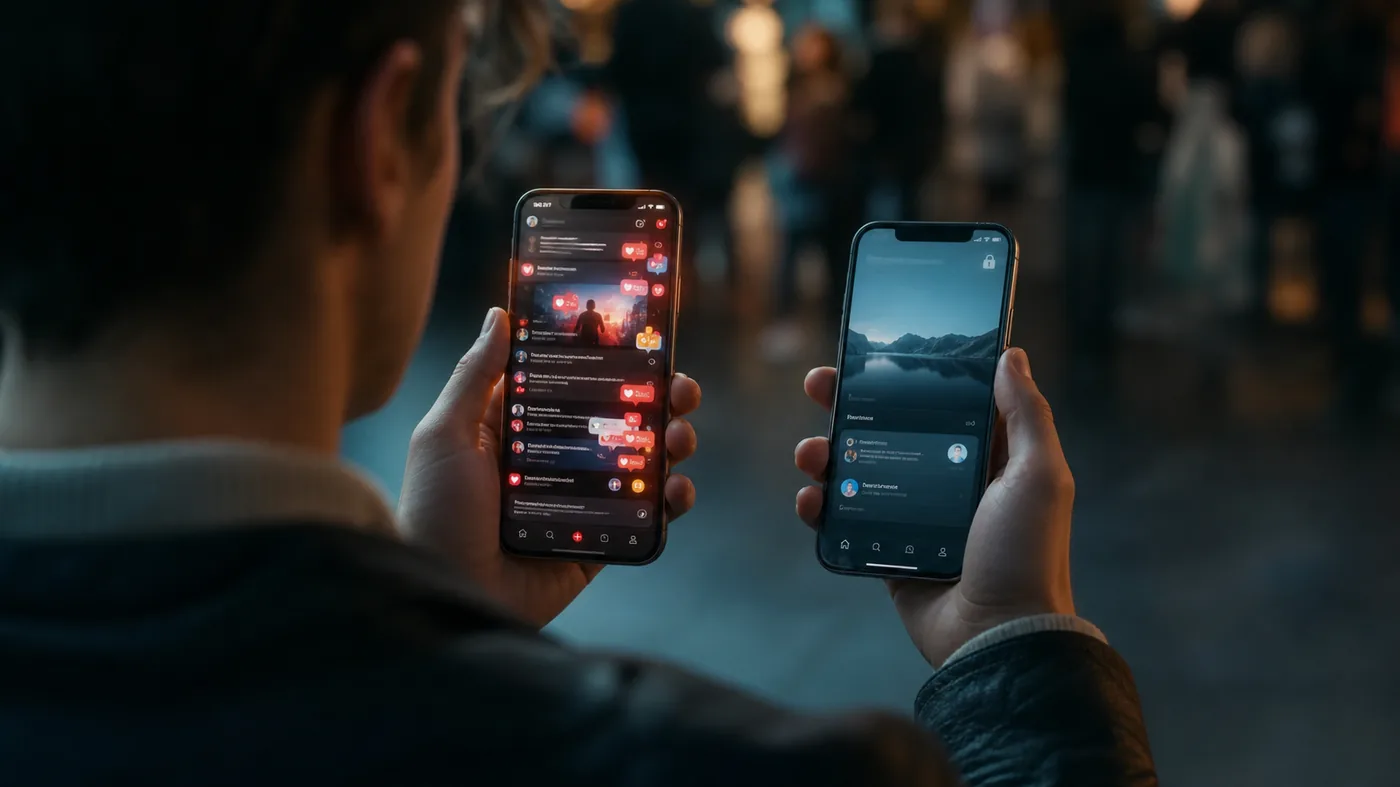
Social media platforms were not designed to undermine democracy. But they were not designed to strengthen it either. Why Europe must break the convenience loop.
I use WhatsApp. You probably do too. And even if you believe Signal is safer, cleaner, or simply a better choice, you know how hard it is to actually make the switch. Not because the technology is difficult. But because everyone is already on WhatsApp.
That is the real challenge of digital change: not technology, but habit. May 9th a European Social Platform called W Social will launch. I'd like to share some thoughts.
Social media works the same way, only at a much larger scale. We all sense that something is wrong. We know our attention is being steered. We know algorithms decide what we see. We know bots, ragebait, polarisation and disinformation are no longer occasional side effects, but part of the environment we move through every day.
And still, we keep scrolling.
Because it is easy. Because our network is there. Because journalists are there. Because politicians are there. Because breaking news often appears there first. Because leaving means risking invisibility.
That is what makes the debate about social media so difficult. It is too simplistic to say that platforms like X, Facebook, Instagram or TikTok are merely harmful. They are not. Social media has real public value. It gives citizens a voice, accelerates news distribution, enables direct communication and allows journalists, experts, companies and activists to reach audiences without relying entirely on traditional gatekeepers.
X is perhaps the clearest example. Pew Research found that X functions more strongly as a news destination than Facebook, Instagram or TikTok. Three quarters of X users say they see breaking news unfold on the platform, and among people who regularly get news on X, eight in ten say they get news from journalists or news organisations.
But that is exactly why the problem is so serious.
When platforms become part of our public infrastructure, we can no longer treat them as ordinary apps.
The biggest problem is not one offensive post, one billionaire owner, one data breach or one rogue algorithm. The biggest problem is the model. The dominant social media platforms are built around attention. Not truth. Not nuance. Not democratic quality. Attention.
And attention has a dark side.
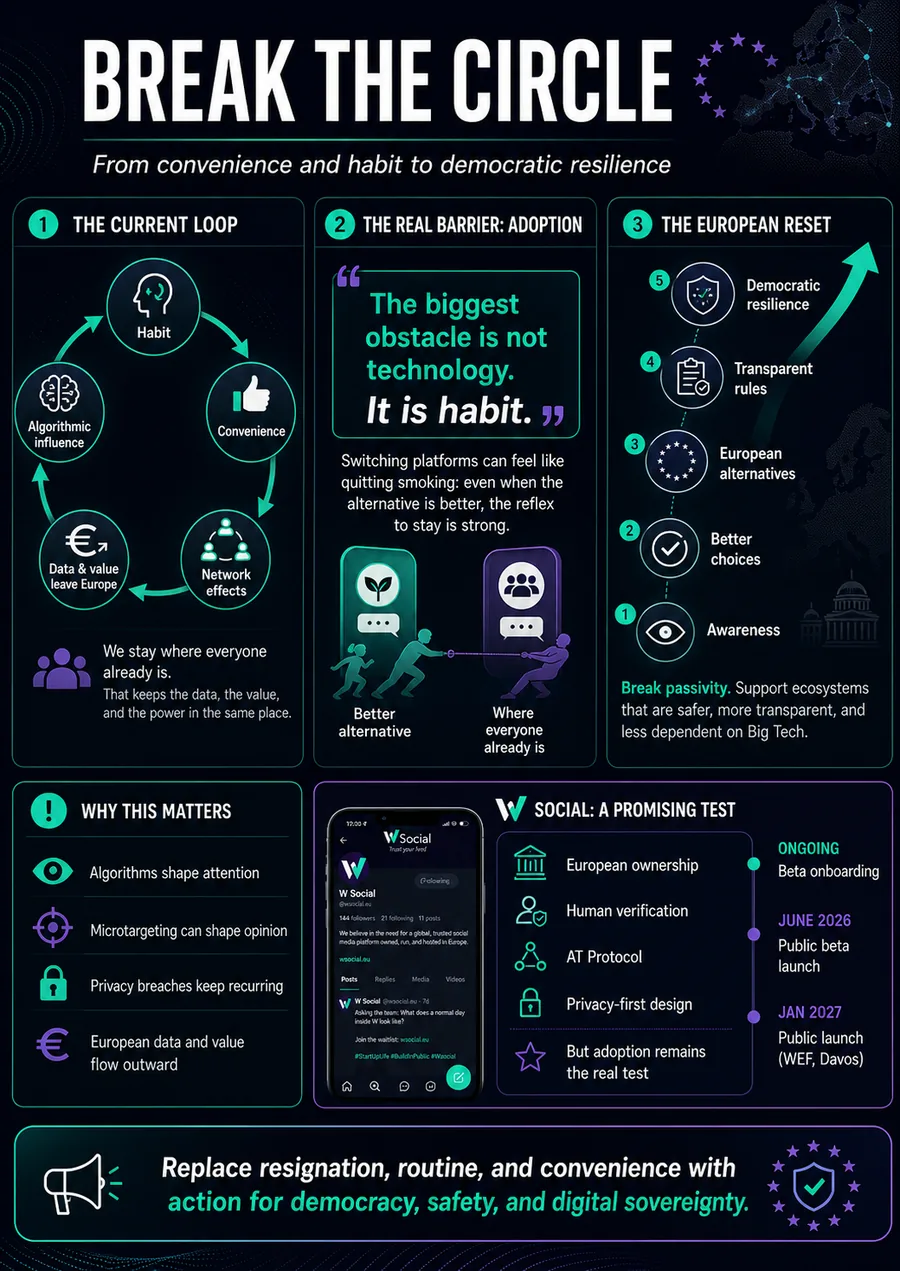
Anger works. Fear works. Identity works. Conflict works. If a platform's goal is to keep people engaged for as long as possible, it will naturally favour content that triggers, divides or compels. The European Parliamentary Research Service describes the democratic risks of social media through five lenses: surveillance, personalisation, disinformation, moderation and microtargeting. In the same analysis, it makes a crucial point: some of these effects flow from a business model focused on "engagement at all costs".
That is the heart of the issue.
These platforms may not have been designed to undermine democracy. But they were not designed to strengthen it either. They were designed to optimise attention.
This is where the algorithmic problem begins. Algorithms do not simply reflect what is popular. They help make things popular. They decide which stories rise, which emotions spread, which voices are amplified and which frames dominate the public conversation.
That is influence at scale. Often subtle. Often invisible. And therefore powerful.
Political microtargeting makes this even more concerning. The European Parliament describes political microtargeting as both intrusive and covert, because it relies on large amounts of personal data and can show different political messages to different people without proper public scrutiny. That can affect citizens' autonomy and the quality of democratic decision-making.
This is why I value initiatives as W Social.
The sovereignty layer
For Europe, there is a second layer to this problem: dependency.
The social media debate is not only about privacy. It is also about sovereignty. We provide the users, the data, the attention, the advertising budgets and often the journalistic content. But the infrastructure, the algorithmic power and the economic value largely sit outside Europe.
Data and value flow out.
That may sound abstract, but it is not. When European companies advertise on American platforms, part of their marketing value leaves the European ecosystem. When European media depend on foreign distribution platforms, they lose control over their relationship with readers. When European citizens receive political information through non-European algorithms, part of our public sphere is shaped by systems we do not control.
The Draghi report states that Europe largely missed the internet revolution and the productivity gains it created. The EuroStack report goes further, arguing that power in the digital economy is concentrated among a small number of non-European players, limiting Europe's ability to innovate, compete and maintain control over its digital economy and wider democratic structures.
This is why European fines and investigations against Big Tech are not bureaucratic theatre. They touch fundamental questions of power, privacy and democracy.
Meta received a €1.2 billion GDPR fine over transfers of Facebook personal data to the United States. TikTok was fined €530 million over transfers of EEA user data to China and transparency failures. X received a €120 million fine under the Digital Services Act for deceptive design, insufficient advertising transparency and insufficient data access for researchers.
But fines are not enough.
They may correct behaviour, but they do not break habit. They may force platforms to become more careful, but they do not build an alternative ecosystem. And that has been one of Europe's recurring weaknesses: we regulate better than we build.
The W Social Platform
That is why initiatives such as W Social are interesting. Not because W Social is automatically the answer. It is far too early to say that. But because it tries to address the problem at the root: European ownership, European hosting, verified human users, fewer bots, more transparency and interoperability through the AT Protocol.
According to W Social's own privacy notice, the platform is built on the AT Protocol and separates W Social from W Identity, with identity verification handled separately. In interviews, W positions itself as a European alternative that wants to allow pseudonyms, reduce bots and support journalistic content through micropayments and revenue sharing.
That sounds promising. But the biggest challenge is not technology.
The biggest challenge is adoption.
And this brings us back to WhatsApp and Signal. Many people like the idea of Signal. It feels safer, calmer, more principled. But if your family, friends, clients and colleagues are all on WhatsApp, switching feels like excluding yourself. Even if everyone installs Signal, habit still pulls people back. It is almost like quitting smoking. You know the alternative is better, you have it in your hand, but the reflex is deeply embedded.
For W Social, the challenge is even harder.
A social platform is not a tool you choose alone. It is a place you go because others are there. Journalists need to be there. Politicians need to be there. Experts need to be there. Media organisations need to be there. And users need to feel that they are not missing out.
That means the assignment is bigger than "build a better platform".
The real assignment is: build a movement.
A European social media platform will only succeed if it is not sold merely as the moral alternative. It must become a better everyday product. Faster where speed matters. More reliable where trust matters. More useful for journalism. Safer for public debate. Less polluted by bots. And, above all, not boring.
Because let us be honest: people do not switch at scale because a platform is compliant. They switch when that is where things happen. When the conversations are there. When the news breaks there. When the quality is there. When the energy is there.
That is why European alternatives cannot rely only on privacy or sovereignty. They must appeal to pride, urgency and convenience. They must make people feel that we are not merely passive users of systems designed elsewhere, but active builders of our own digital public space.
Breaking the Loop
The loop we need to break is simple.
We stay where everyone already is. So the data stays there. So the value stays there. So the algorithms become more powerful. So the alternative becomes harder.
You do not break that loop with outrage alone. You break it with deliberate choices. With companies that seriously test European alternatives. With media organisations that do not merely complain about platform dependency, but experiment with new distribution models. With politicians and executives who understand that digital infrastructure is as strategic as energy, defence or telecom. And with users who are willing, sometimes, to put something higher than convenience.
Not because we are anti-American. Not because every European alternative is automatically better. But because democracy, safety and autonomy require more than convenience.
The question is not whether we should all leave X, WhatsApp, Instagram or TikTok tomorrow.
The question is whether we will keep pretending there is no choice.
Because resignation may be the most dangerous habit of all.
Originally published on LinkedIn Pulse — May 4, 2026.

Benieuwd wat AI voor jouw organisatie kan betekenen? Laten we kijken wat er mogelijk is.
Neem contact op